Accessory dwelling units represent one of California’s most strategic property investments, yet most owners overlook a critical risk factor. While ADU builders handle design, permitting, and construction, water damage costs average $14,000 per incident across multifamily properties. Smart leak detection systems integrated during construction reduce these claims by 96%, transforming ADUs from potential liabilities into protected revenue streams. This guide shows you how to select the right builder, navigate California’s unique permitting landscape, and embed proactive water management into your ADU project from day one.
- What do ADU builders do?
- The full ADU process: From concept to completion
- Comparing ADU types and costs in California
- Critical permitting and compliance considerations
- Integrating smart leak detection into ADU projects
- ROI and ongoing management: ADUs plus leak detection
- How LeakSense supports smart ADU solutions in California
- Frequently asked questions
Key Takeaways
| Point | Details |
|---|---|
| End-to-end builder value | Design-build ADU firms streamline complex processes and boost on-time, on-budget success. |
| Critical legal insights | Jurisdictional rules, 60-day approvals, and utility reviews are decisive for multifamily ADU projects. |
| Smart leak protection | Integrating AI-driven leak detection reduces insurance claims by up to 96% and prevents costly water damage. |
| Multifamily ROI boost | Strategic ADU investments return $350 or more per month in new rental income plus major insurance savings. |
| Ongoing analytics benefits | Real-time water analytics optimize property operations and support regulatory compliance effortlessly. |
What do ADU builders do?
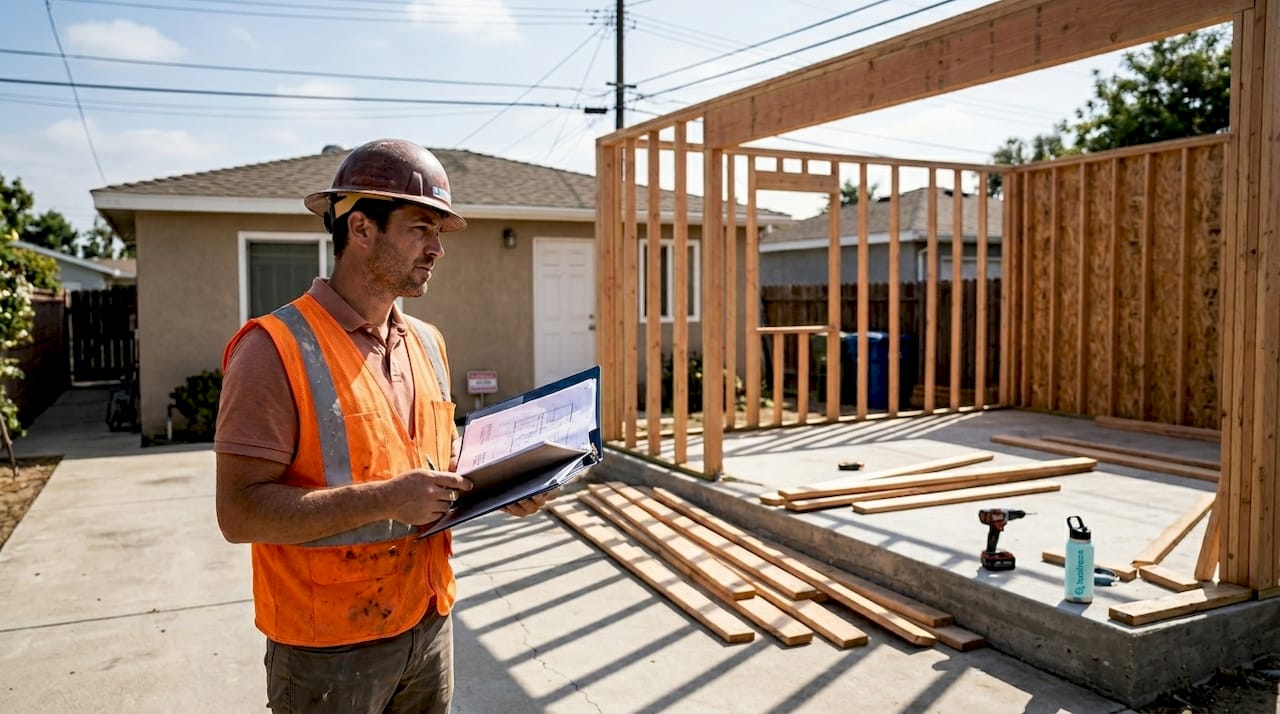
ADU builders in California manage the complete project lifecycle using a design-build model that consolidates architecture, engineering, permitting, and construction under one contract. This approach eliminates coordination delays between separate firms and reduces change orders that typically inflate costs by 15-20% in traditional bid-build projects.
For multifamily and commercial properties, specialized ADU builders offer distinct advantages:
- Feasibility analysis evaluating site constraints, zoning compliance, and utility capacity before design begins
- Architectural design optimized for California building codes and local jurisdiction requirements
- Structural and MEP engineering ensuring systems integration and Title 24 compliance
- Permit expediting leveraging established relationships with city planning departments
- Construction management coordinating subcontractors and inspection schedules
- Final inspections securing certificate of occupancy and utility connections
The design-build structure proves especially valuable for property managers overseeing multiple assets. SnapADU delivers over 100 units with consistent on-time performance by maintaining in-house teams rather than relying on general contractor networks.
Pro Tip: Choose builders with documented California multifamily experience. Local specialists navigate ministerial permitting 40% faster than out-of-state firms unfamiliar with regional compliance nuances.
When evaluating builders, prioritize those who coordinate early with utility providers and step-by-step leak detection specialists. Water infrastructure planning during feasibility prevents costly retrofits after construction. Builders like Villa Homes integrate automatic leak detection systems into their standard MEP specifications, reducing post-occupancy insurance claims significantly.
The full ADU process: From concept to completion
California ADU projects follow a structured timeline with regulatory checkpoints that directly impact your investment schedule. Understanding each phase helps you plan cash flow and coordinate leak detection installation at optimal points.
1. Site feasibility and design (Months 1-3) Builders assess zoning compliance, utility capacity, and soil conditions. This phase determines whether your property supports detached, attached, or conversion ADUs. Request water infrastructure analysis now to identify if main line upgrades or separate metering will be required.
2. Architectural plans and engineering (Months 3-5) Detailed drawings specify structural, electrical, plumbing, and mechanical systems. Coordinate with your builder to include leak detection installation steps in the plumbing specifications. Clamp-on sensors and shutoff valves integrate seamlessly when planned during this phase.
3. Permit submission and approval (Months 5-7) California law mandates 60-day ministerial review for compliant ADU applications, eliminating discretionary hearings that previously delayed projects by months. Multifamily properties benefit from streamlined approval since parking and owner-occupancy requirements don’t apply.
4. Site preparation and foundation (Months 7-9) Grading, utility trenching, and foundation work begin. This is your last opportunity to install main water line monitoring before concrete pours. Engineering inspections verify structural compliance before framing starts.
5. Framing and MEP rough-in (Months 9-12) Walls, roof, and utility systems take shape. Smart leak sensors mount directly to supply lines during plumbing rough-in, providing coverage before drywall conceals pipes. Electricians run low-voltage wiring for monitoring hubs simultaneously.
6. Interior finishes and final inspections (Months 12-16) Drywall, flooring, fixtures, and appliances complete the unit. Final building, plumbing, and electrical inspections occur before certificate of occupancy issues. Test leak detection systems during this phase to ensure proper calibration.
| Project Phase | Duration | Key Milestones | Leak Detection Integration |
|---|---|---|---|
| Feasibility | 2-3 months | Site analysis, utility review | Plan water infrastructure needs |
| Design/Engineering | 2-3 months | Architectural plans, MEP specs | Specify sensor locations |
| Permitting | 2 months | Ministerial approval | No action required |
| Site Prep | 2-3 months | Foundation, utility trenching | Install main line monitoring |
| Construction | 4-6 months | Framing, MEP, finishes | Mount sensors during rough-in |
| Inspections | 1-2 months | Final approvals, CO issued | System testing and calibration |
Total timeline spans 10-18 months for multifamily and commercial ADU projects. Prefab units compress construction to 4-6 months but still require similar permitting and site preparation periods.
Comparing ADU types and costs in California
Your ADU format decision impacts both upfront investment and long-term operational costs. California’s diverse real estate markets show significant regional variation, with water management considerations influencing total cost of ownership.
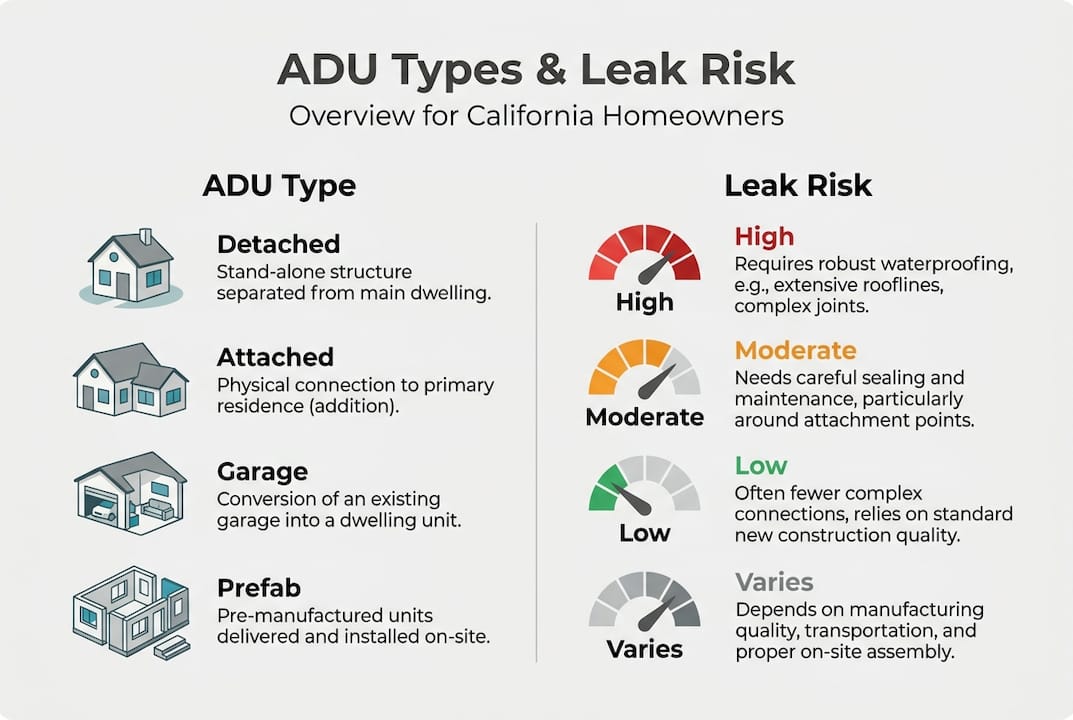
| ADU Type | Cost Range | Best For | Water Risk Factors |
|---|---|---|---|
| Detached | $200k-$400k+ | Maximum rental income, separate utilities | Independent plumbing requires dedicated leak monitoring |
| Attached | $150k-$300k | Lower site prep costs, shared utilities | Leaks can affect primary structure |
| Garage Conversion | $100k-$175k | Existing foundation, fastest completion | Limited plumbing access for retrofits |
| Junior ADU | $50k-$100k | Within existing footprint, no kitchen | Shares main building water system |
| Prefab/Modular | $150k-$250k | 15-25% cost savings, controlled quality | Factory-installed plumbing simplifies sensor integration |
Bay Area construction costs reach $450-$600 per square foot, while Central Valley projects average $250-$350 per square foot. These regional differences stem from labor rates, permit fees, and utility connection charges rather than material costs.
Cost drivers beyond base construction:
- Utility infrastructure upgrades for water, sewer, electrical service ($5k-$25k)
- Separate metering required for tenant billing compliance ($2k-$5k per utility)
- Landscaping and site work to restore disturbed areas ($3k-$15k)
- Impact fees varying by jurisdiction ($5k-$20k)
- Smart building systems including leak detection and monitoring ($1.5k-$4k)
Prefab ADUs from providers like MEKA deliver factory-built quality with integrated plumbing that accommodates best leak detection systems during manufacturing. This approach reduces on-site plumbing labor by 30-40% while improving system reliability.
ROI consideration: Bay Area ADUs generating $2,500-$3,500 monthly rent produce net returns of $350+ per month after mortgage, insurance, and operating costs. Properties with documented leak prevention systems qualify for 10-15% insurance premium reductions, improving cash flow from day one.
Critical permitting and compliance considerations
California’s ADU legislation creates opportunities that many property managers overlook, particularly for multifamily and commercial applications. Understanding these regulatory advantages prevents delays and unlocks hidden value.
Multifamily-specific benefits:
- No owner-occupancy requirement unlike single-family ADU rules
- Parking exemptions within half-mile of transit corridors
- HOA restriction limits preventing associations from blocking compliant projects
- Expedited ministerial review mandated within 60 days for code-compliant applications
- Reduced setback requirements in urban infill zones
Utility infrastructure often presents the most significant permitting challenge. Water and sewer capacity must support additional units, requiring early coordination with municipal providers. Properties near capacity limits may need main line upgrades costing $15k-$40k before ADU approval.
Pro Tip: Request a utility will-serve letter during feasibility analysis. This document confirms adequate capacity and prevents permit rejection after investing in design work. Builders with established utility relationships secure these letters 60% faster than property owners navigating the process independently.
Site-specific zoning considerations include:
- Setback variances for properties with unusual lot configurations
- Height limits typically 16 feet for single-story, 25 feet for two-story ADUs
- Lot coverage maximums ranging from 30-50% depending on jurisdiction
- Fire safety access requiring minimum clearances for emergency vehicles
Builders like Urbatect specialize in multifamily ADU projects and maintain current knowledge of evolving local interpretations. Their expertise proves valuable when jurisdictions apply discretionary standards to ministerial applications.
Integrate water submetering planning into your permit strategy. California requires separate metering for new multifamily units, and coordinating this with leak detection creates a unified water management system that satisfies compliance while reducing operational costs.
Integrating smart leak detection into ADU projects
Water damage represents the largest insurable risk for ADU investments, yet most builders treat leak detection as an afterthought. Strategic integration during construction delivers maximum protection at minimum cost.
Optimal installation timing:
- Design phase: Specify sensor locations in plumbing plans, ensuring coverage of water heaters, supply lines, washing machine connections, and bathroom fixtures
- MEP rough-in: Mount clamp-on flow sensors to main supply lines and branch circuits before drywall installation
- Electrical rough-in: Run low-voltage wiring for monitoring hubs and shutoff valve controllers simultaneously with standard electrical work
- Pre-drywall inspection: Test sensor communication and calibrate flow baselines while access remains easy
- Final walkthrough: Configure alert thresholds and train property management staff on monitoring protocols
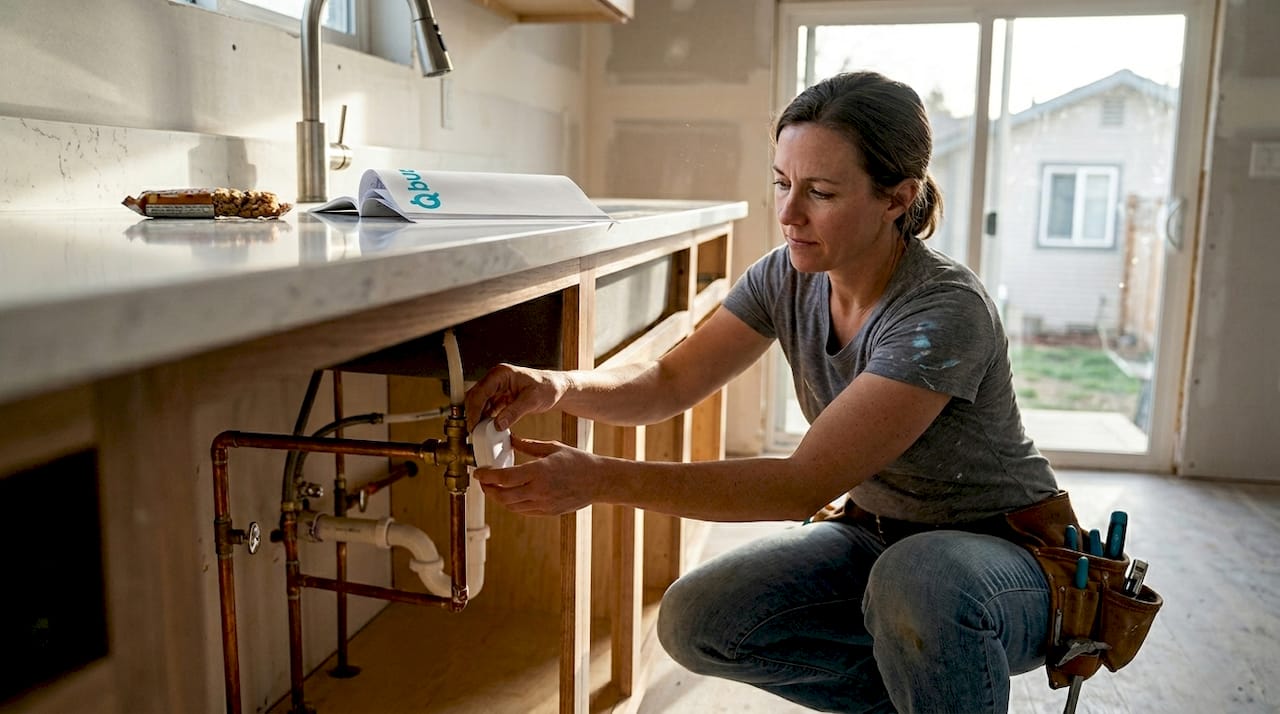
Clamp-on ultrasonic sensors offer significant advantages for new construction. These devices measure flow without cutting pipes, reducing installation labor by 70% compared to inline meters. Ultrasonic and AI-based systems reduce claims by 96% by detecting microleaks before they cause visible damage.
Pro Tip: Coordinate leak detection with your fire sprinkler contractor if installing NFPA 13D systems. Integrated monitoring distinguishes between intentional sprinkler discharge and supply line leaks, preventing false alarms that plague standalone systems.
Real-world performance data shows compelling results:
- 70% of systems detect microleaks within the first 30 days of operation
- Average claim prevention of $14,000 per incident across multifamily properties
- Insurance premium reductions of 10-15% for properties with certified monitoring
- Utility rebates up to $500 per unit in select California water districts
Modern systems integrate with property management software, sending alerts via text, email, and mobile apps. Automated shutoff valves respond within 3 seconds of detecting catastrophic flow, preventing the toilet supply line failures that cause 78% of ADU water damage claims.
For apartment leak detection strategies, consider whole-building analytics that aggregate data across multiple ADUs. This approach identifies systemic issues like pressure surges or aging infrastructure before individual unit failures occur. Cloud-based water analytics platforms provide portfolio-level visibility for property managers overseeing multiple sites.
ROI and ongoing management: ADUs plus leak detection
Successful ADU investments require proactive management that extends beyond construction completion. Integrating water analytics into your operational workflow transforms leak detection from a passive safety system into an active revenue protection tool.
Ongoing operational benefits:
- Real-time monitoring eliminates surprise water bills and identifies tenant usage anomalies
- Automated alerts enable rapid response before minor leaks escalate to insurance claims
- Usage analytics support accurate tenant billing and identify conservation opportunities
- Compliance documentation for California water efficiency reporting requirements
- Predictive maintenance flagging fixtures and appliances approaching failure
Financial performance metrics demonstrate clear value. Properties with integrated leak detection and submetering show:
- 96% reduction in water damage insurance claims
- $350+ monthly net income from Bay Area ADU rentals after all operating costs
- 15-20% lower water costs through conservation and leak elimination
- 10-15% insurance premium savings with certified monitoring systems
Critical follow-up actions for property managers:
- Monthly data review: Analyze usage patterns and alert history to identify trends
- Quarterly system testing: Verify sensor accuracy and communication reliability
- Annual service agreements: Maintain manufacturer warranties and software updates
- ROI tracking: Document claim prevention and operational savings for portfolio reporting
- Tenant education: Provide guidelines for normal usage and alert response procedures
ADUs increase net rental income significantly while smart leak systems prevent nearly all avoidable water losses. This combination creates a compounding effect where protected revenue streams support faster equity building and portfolio expansion.
For properties with multiple ADUs, centralized 24/7 leak monitoring provides economies of scale. Single monitoring contracts covering 5-10 units cost 40% less per unit than individual system subscriptions, while delivering superior analytics through aggregated data.
Key takeaways for maximizing ADU investment returns:
| Strategy | Implementation | Impact |
|---|---|---|
| Early leak detection planning | Specify during design phase | 70% lower installation costs |
| Integrated submetering | Combine with leak sensors | Accurate tenant billing, compliance |
| Proactive monitoring | Monthly data review | Prevent 96% of damage claims |
| Insurance optimization | Document monitoring systems | 10-15% premium reduction |
| Portfolio analytics | Centralized platform | Identify systemic issues early |
How LeakSense supports smart ADU solutions in California
Protecting your ADU investment requires specialized expertise in both California building standards and advanced water management technology. LeakSense delivers integrated solutions designed specifically for multifamily and commercial property applications.
Our automatic leak detection solutions install seamlessly during ADU construction, providing real-time monitoring and automated shutoff capabilities that prevent catastrophic damage. We coordinate directly with your builder during the MEP phase, ensuring optimal sensor placement and system integration without construction delays.
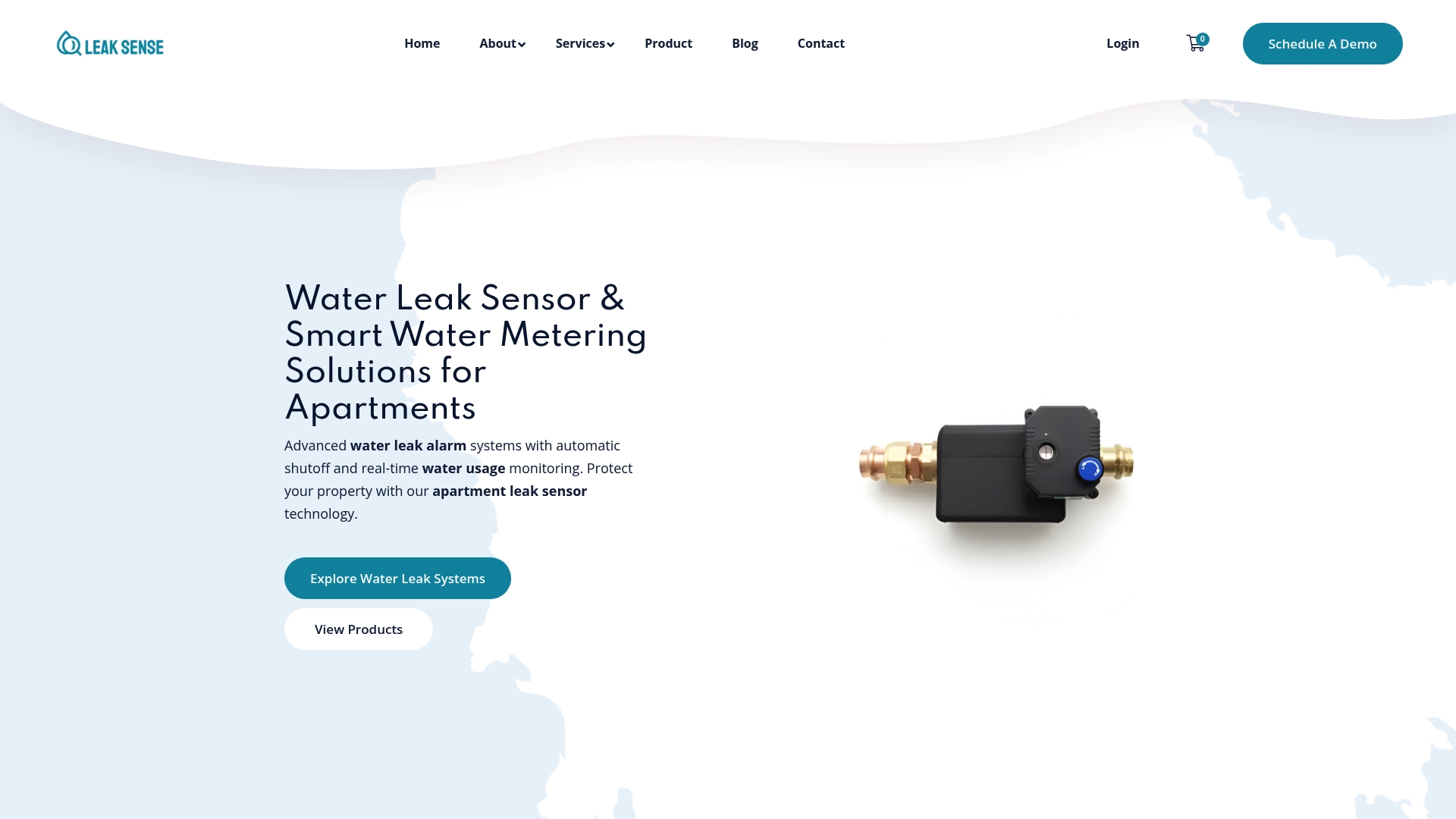
For properties requiring tenant billing compliance, our water submetering systems combine accurate usage tracking with leak detection in a unified platform. This approach satisfies California’s separate metering requirements while delivering the operational insights property managers need for proactive maintenance.
Our water analytics for multifamily properties provides portfolio-level visibility across multiple ADUs and buildings. Cloud-based dashboards aggregate data, identify trends, and generate compliance reports that streamline regulatory requirements and insurance documentation.
LeakSense specializes in California Title 24 compliance and works with leading ADU builders throughout the state. Our systems qualify for utility rebates, insurance discounts, and LEED certification points, maximizing your return on investment from day one. Contact us to discuss how we can tailor a solution for your specific ADU project and property management needs.
Frequently asked questions
What is the typical ADU construction timeline in California for multifamily properties?
The full process takes 10-18 months, including planning, design, permitting, construction, and inspections. Prefab units can reduce construction time to 4-6 months but still require similar permitting periods.
How much do ADUs cost in California in 2026?
Costs range from $100,000 for garage conversions to over $400,000 for detached ADUs, with Bay Area prices reaching $450-$600 per square foot. Regional labor rates and permit fees drive most cost variation.
What are the main permitting challenges for ADUs in multifamily or commercial properties?
Site zoning, utility capacity, and local compliance must be addressed, but California law mandates 60-day ministerial ADU approvals. Utility will-serve letters often present the most significant hurdle for properties near capacity limits.
How do smart leak detection systems integrate with new ADUs?
These systems install during plumbing rough-in and provide real-time water monitoring plus auto-shutoff to prevent costly damage. Clamp-on sensors mount to supply lines before drywall, reducing installation costs by 70% compared to retrofits.
Can ADUs be built for commercial or multifamily properties?
Yes, California allows ADUs for multifamily and even some commercial sites, often unlocking significant ROI for property owners. These projects benefit from streamlined permitting and no owner-occupancy requirements that apply to single-family ADUs.
Recommended
- How to Set Up Leak Detection Systems for Multifamily Buildings
- Water Damage Prevention Explained: Smart Tech for California Property
- Moen alternative guide 2026: Save 30% on leak detection costs
- Why use leak detection for multifamily buildings in CA
- Civil Engineering Basics for Homeowners: Ensure Safe Renovations - Florida Licensed Engineers