
TL;DR:
- Real-time leak alarms detect water intrusions within seconds, reducing costly damages.
- Advanced systems combine multiple sensors with AI analytics for high accuracy and low false alarms.
- Full coverage hybrid leak detection systems enhance regulatory compliance, insurance benefits, and asset protection.
A single undetected pipe leak in a multifamily building can cost tens of thousands of dollars in structural repairs, mold remediation, and tenant displacement, and that figure does not include the regulatory fines California property managers face for water waste under Title 24. Yet many buildings still rely on periodic inspections or basic moisture strips that notify no one in real time. Modern real-time leak alarms detect and send alerts in seconds, turning what used to be a slow, expensive discovery process into an immediate, manageable event. This guide defines what these systems are, how they work, how accurate they are, and how to choose the right approach for your California property.
- What are real-time leak alarms?
- How do real-time leak detection systems work?
- How accurate and fast are today’s real-time leak alarms?
- Common pitfalls and how to avoid false alarms
- Comparing detection strategies: Point sensors vs. acoustic vs. hybrid systems
- Why full-coverage, AI-powered leak detection is the new normal in California
- Ready to upgrade your property with real-time leak alarms?
- Frequently asked questions
Key Takeaways
| Point | Details |
|---|---|
| Automatic, instant alerts | Real-time leak alarms notify you within seconds of moisture detection through connected apps or devices. |
| Advanced sensor fusion | Blending multiple detection technologies and AI dramatically raises accuracy while reducing false alarms. |
| ROI and compliance benefits | Modern systems help California properties save on insurance and avoid regulatory issues within two years. |
| Hybrid systems recommended | Best results come from combining point, acoustic, and flow sensors for comprehensive monitoring. |
What are real-time leak alarms?
Real-time leak alarms are a distinct category of water management technology. The name matters, because not every “leak detector” on the market earns that label honestly.
Real-time leak alarms are automated systems using sensors to detect leaks and send instant alerts the moment water is found where it should not be. That is the core definition. What separates them from scheduled or reactive systems is the time gap between detection and notification.
Scheduled monitoring relies on periodic meter reads or manual inspections. A leak that starts on a Tuesday might not be discovered until the following Friday walkthrough. Reactive alarms wait until damage is visible or a tenant reports a wet floor. By that point, water has already compromised drywall, subfloor, or insulation.
Real-time systems, by contrast, close that gap to seconds. Consider what that means for a 100-unit apartment building in Los Angeles. A pinhole leak behind a bathroom vanity runs unnoticed for 72 hours in a reactive system setup. In a real-time setup, your phone receives an alert within seconds of the sensor detecting moisture, and maintenance can shut off the supply line before the water reaches adjacent units.
“The difference between a $500 repair and a $50,000 restoration is almost always how quickly the leak was found.” This is a pattern we see repeatedly in California multifamily properties.
Types of alerts real-time systems can deliver:
- Push notifications to a mobile app
- SMS text messages to property managers and maintenance staff
- Email alerts with sensor location data
- Audible on-site sirens to prompt immediate action
- Automated shutoff signals to connected valve controllers
- Dashboard flags inside property management software
The result of this immediacy is significant. Properties that invest in reducing water damage through real-time monitoring report incident costs that are dramatically lower than those relying on manual detection. Speed is the single biggest factor in limiting water damage severity.
How do real-time leak detection systems work?
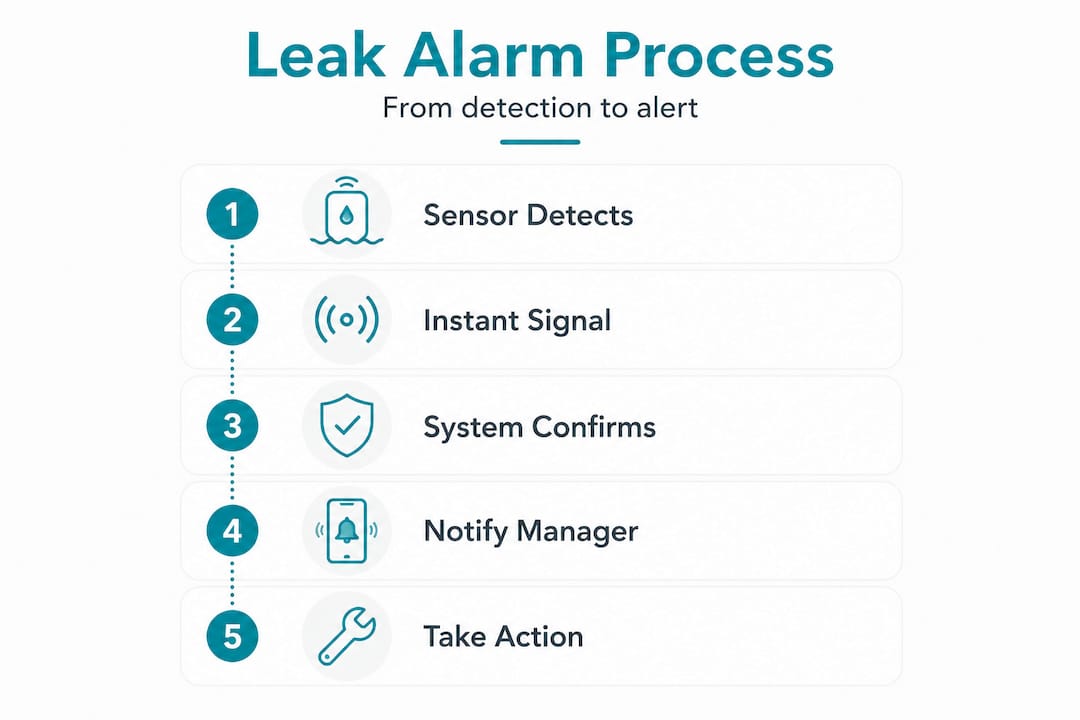
Understanding the mechanics helps you evaluate vendors and ask the right questions during procurement. Here is a step-by-step view of what happens from the moment water escapes a pipe to the moment you receive an alert.
- Water contacts or disrupts a sensor. A moisture pad detects conductivity change, a flow meter registers an anomalous volume, or an acoustic sensor picks up pipe vibration consistent with a leak signature.
- The sensor transmits raw data. Modern IoT (Internet of Things) sensors send data wirelessly via Wi-Fi, Z-Wave, Zigbee, or cellular to a local hub or cloud server, often within milliseconds.
- Software processes the data. AI-driven algorithms compare incoming readings against established baselines and known leak patterns. This is where smart systems outperform simple threshold alarms.
- An alert is generated and dispatched. If the analysis confirms a leak event, the platform sends notifications through pre-configured channels simultaneously.
- Optional automated response activates. Advanced systems can trigger a remote shutoff valve to stop water flow before any person intervenes.
Primary detection technologies used in real-time systems span four methodologies, including point sensors, acoustic/vibration units, flow meters, and AI data analysis.
| Technology | How it detects | Best use case |
|---|---|---|
| Point moisture sensors | Electrical conductivity change | Under sinks, near appliances, in mechanical rooms |
| Acoustic/vibration sensors | Sound signatures in pipes | Hidden pipes, buried mains, inaccessible risers |
| Flow meters | Abnormal volume or pressure | Building entry points, irrigation lines, utility mains |
| AI pattern analysis | Behavioral deviations from baseline | Portfolio-wide monitoring, slow leak identification |
Exploring the types of leak sensors used in multifamily buildings helps clarify which combination makes the most sense for your specific floor plan and building age. Pairing sensor hardware with a water analytics platform gives property managers a continuous, data-rich view of every water system in the building, not just point-in-time snapshots.
Pro Tip: When evaluating vendors, ask whether their platform stores historical sensor data. Without historical data, you cannot identify creeping slow leaks or seasonal anomalies that AI models use to improve accuracy over time.
How accurate and fast are today’s real-time leak alarms?
Performance benchmarks for modern systems are genuinely impressive. And they matter, because an inaccurate alarm that cries wolf too often will quickly be ignored by your maintenance team, negating the entire investment.
Current AI-enhanced benchmarks show greater than 93% accuracy for CivilSense AI systems, 99.9% leak detection for the FiT model in 0.25 seconds, and 92.8% accuracy with a 1.66% false positive rate for CNN-GPR hybrid models. These are not marketing claims; they are measured results from controlled and field-based research environments.
To put that in property management terms:
- A system with 99.9% detection accuracy in a 100-unit building means that out of 1,000 leak events over a year, it would catch 999 of them.
- A 0.25-second response time means your shutoff valve can activate before a cup of water has escaped onto the subfloor.
- A 1.66% false positive rate with CNN-GPR models means fewer unnecessary maintenance dispatches, which directly reduces operational costs.
What drives these performance numbers?
- Larger training datasets that teach AI models to recognize complex leak signatures versus normal pipe sounds
- Multi-sensor fusion, meaning the system cross-checks two or more data streams before triggering an alert
- Continuous model improvement as the system learns your building’s specific baseline behavior over weeks and months
The practical implication for California property managers is that water management with automatic alerts has moved well past the era of simple float switches and moisture strips. Today’s systems combine hardware precision with software intelligence in ways that make speed and accuracy genuinely reliable at building scale.
Key performance stats at a glance:
- Greater than 93% accuracy in real-world AI deployments
- Sub-second alert generation in leading platforms
- False positive rates below 2% in next-generation hybrid systems
- Automated shutoff response within seconds of confirmed detection
Common pitfalls and how to avoid false alarms
Even the best system can be undermined by poor implementation or the wrong configuration. False alarms are the primary reason property managers lose confidence in their detection systems. Understanding where they come from is the first step to eliminating them.
Most frequent sources of false alarms:
- Condensation on pipes or HVAC units triggering moisture sensors not placed correctly
- Fixed threshold settings that cannot distinguish between a humidity spike and an actual leak
- Noisy pipes causing vibration signatures that acoustic sensors misread as leak events
- Seasonal changes in flow patterns that single-baseline systems flag as anomalies
The core problem with older systems is that they use a single fixed threshold: if moisture level exceeds X, trigger an alert. That approach fails in California buildings where summer humidity, irrigation cycles, and tenant behavior shift daily patterns significantly.
“Fixed-threshold systems set for a dry January will produce constant false alerts during a humid August. Dynamic systems adapt. Static systems frustrate.”
Dynamic baselines can reduce false alarms by up to 100 times compared to fixed-threshold systems, and sensor fusion approaches can push overall accuracy to 99%. That is a dramatic improvement that directly translates to fewer unnecessary maintenance dispatches and higher team trust in the system.
Actionable steps to reduce false alarms in your building:
- Choose a platform that learns and updates baselines continuously rather than using a set-and-forget threshold
- Deploy multi-sensor setups so alerts require confirmation from at least two independent data sources
- Position point sensors away from known condensation zones like HVAC drain pans, unless those areas are specifically being monitored
- Schedule a calibration review after the first 30 days of deployment when the AI has gathered initial baseline data
Understanding 24/7 leak detection best practices and following a step-by-step monitoring approach significantly lowers the risk of alert fatigue, which is what happens when maintenance staff start dismissing notifications because too many have been false positives in the past.
Pro Tip: Request a false positive rate report from your vendor for installations similar to yours. Any reputable provider should be able to share real-world performance data from comparable California properties.
Comparing detection strategies: Point sensors vs. acoustic vs. hybrid systems
Every detection method has a specific strength. The mistake many property managers make is choosing one method exclusively and expecting it to cover every scenario. Here is how each strategy performs in real California building conditions.
Point sensors are best for localized spots, acoustic sensors excel at detecting hidden pipe leaks, hybrid systems lower false alarms overall, and flow sensors alone tend to miss slow leaks. Each method fills a different gap.
| Detection method | Strengths | Limitations | Best fit |
|---|---|---|---|
| Point moisture sensors | Low cost, easy install, precise location | Miss leaks between sensor locations | Under-sink cabinets, appliances, mechanical rooms |
| Acoustic/vibration sensors | Detect hidden and pressurized pipe leaks | Sensitive to background noise | Buried mains, risers, inaccessible chases |
| Flow meters | Catch sustained usage anomalies | Slow to flag fast-burst leaks | Building entry, irrigation, utility mains |
| Hybrid AI systems | High accuracy, low false alarms, adaptable | Higher upfront cost | Large multifamily and commercial buildings |
For a mid-size California apartment building with 50 or more units, a purely point-sensor strategy would require hundreds of individual devices and still leave pipe sections unmonitored. A purely acoustic setup might miss surface-level appliance leaks that point sensors catch instantly.
Recommended deployment sequence for large multifamily buildings:
- Install flow meters at the building main and each unit’s supply line entry
- Add point moisture sensors at high-risk locations including under sinks, near water heaters, and at HVAC drain connections
- Deploy acoustic sensors on main risers and any inaccessible pipe runs in wall cavities
- Connect all sensors to an AI-powered platform that fuses data streams and manages dynamic baselines
- Configure automated alerts and, where possible, link to remote shutoff valves at the main and submetered points
Reviewing best leak detection systems for multifamily buildings gives a practical comparison of leading options and how they perform in California-specific regulatory contexts, particularly around Title 24 water conservation requirements.
Why full-coverage, AI-powered leak detection is the new normal in California
Here is something most guides will not tell you directly: choosing a single-method detection system is almost always a false economy for multifamily property managers in California.
We have seen it play out repeatedly. A building owner installs point sensors at visible risk spots, saves money upfront, and then faces a slow leak behind a riser that goes undetected for three months because there was no acoustic or flow monitoring on that section. The repair bill exceeds the cost of a full hybrid system several times over. The lesson is not subtle.
The business case for full-coverage AI hybrid systems is stronger than most property managers initially assume. Consider three dimensions:
Insurance: Several California insurers now offer premium discounts of 5% to 15% for properties with documented, certified real-time leak detection in place. That discount compounds annually and can offset hardware costs within 12 to 18 months on a large building.
Regulatory compliance: California’s Title 24 and local water district mandates increasingly require verifiable water conservation measures. A documented real-time system provides exactly the kind of audit trail regulators want to see, reducing exposure to penalties.
Avoided loss: The average water damage claim in a California multifamily property exceeds $12,000. One prevented incident per year on a 100-unit building generates a clear return that makes the investment argument straightforward.
The real challenge is not cost. It is inertia. Many property managers inherit legacy systems or no systems at all and assume replacement is a large, disruptive project. Modern IoT systems install with minimal disruption, often without opening walls, and integrate with existing property management platforms. Protecting multifamily assets with AI hybrid detection is not a future aspiration. It is a current, deployable reality.
Our firm perspective: the question is not whether to upgrade, but how fast you can do it before the next incident makes the decision for you.
Ready to upgrade your property with real-time leak alarms?
Leaksense.io designs and deploys real-time water leak detection systems built specifically for California’s multifamily and commercial property landscape. Our solutions combine IoT sensor hardware, AI-driven analytics, and automated response tools that integrate seamlessly with existing property management workflows.
Whether you are starting from zero or replacing an outdated system, our team can assess your building’s specific layout, risk profile, and compliance needs. Explore our automatic leak detection service to see how rapid-response systems are deployed in California buildings, or compare water metering solutions to find the right hardware and software combination for your portfolio. For buildings requiring submetering and tenant billing integration, our smart water metering service delivers full-stack water visibility from the main to the unit level. Contact our team today to schedule a site assessment and get a custom ROI estimate for your property.
Frequently asked questions
What makes a leak alarm truly “real-time”?
A real-time leak alarm detects moisture and sends alerts within seconds using automated sensors connected to instant notification systems, rather than waiting for a scheduled inspection or manual report.
How can I minimize false alarms in my building’s leak detection system?
Choose systems that use dynamic baselines to reduce false alerts by up to 100 times compared to fixed-threshold alarms, and pair multiple sensor types so alerts require confirmation from more than one data source.
Do real-time leak alarms fit California regulatory requirements?
Yes. Advanced real-time systems provide the continuous monitoring records and rapid-response documentation that California’s Title 24 and local water district compliance programs increasingly require from multifamily and commercial properties.
Which detection method is best for large apartment buildings?
A hybrid sensor fusion approach combining point sensors, acoustic units, and flow meters managed by an AI platform delivers the best combination of accuracy, coverage, and low false alarm rates for large multifamily properties.
How fast are today’s best real-time leak detection systems?
Leading platforms achieve 99.9% detection accuracy in 0.25 seconds, making it possible to trigger automated shutoff valves before significant water volume escapes the pipe.